Cultural policy, heritage, Irish and international landscape law, social, environmental, human and cultural rights, routes to spatial justice, (re)defining landscape with Amy Strecker, Associate Professor at UCD Sutherland School of Law.
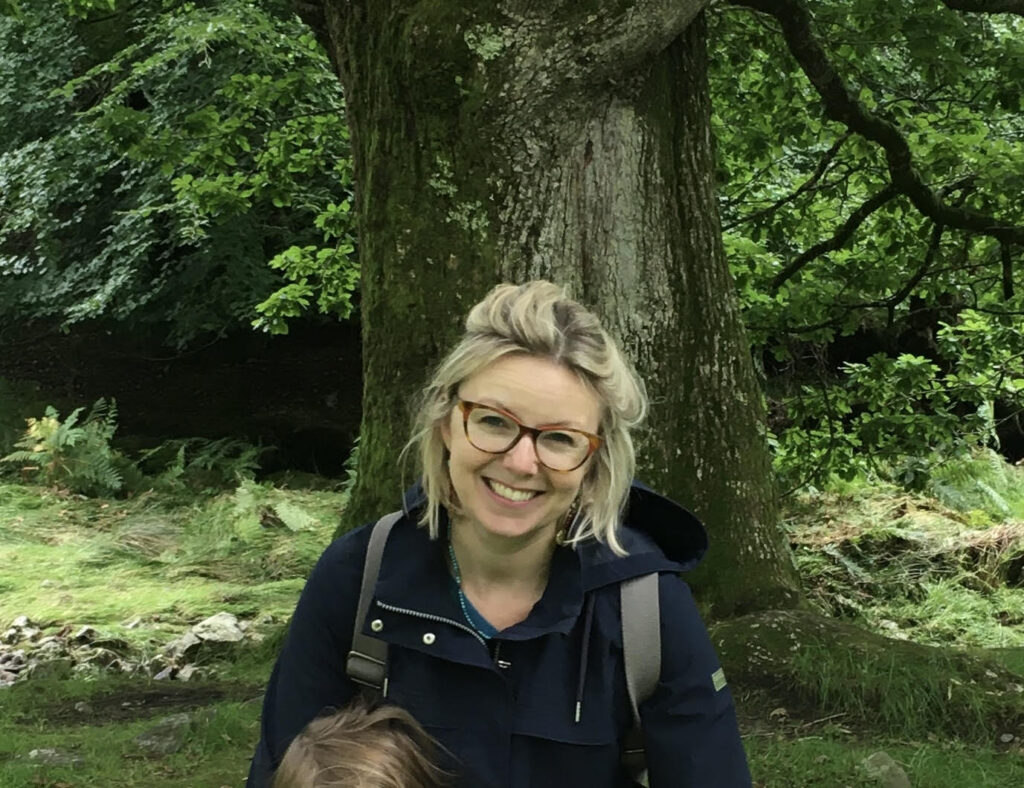
Q: Can you tell us a bit about your academic background, how you came to what you do now and what disciplines you draw on?
A: I started off studying humanities as an undergraduate in UCD and became interested in law when I came back to do an MA in Cultural Policy, which included law and cultural policy modules. This was in 2004, the height of the Celtic Tiger and major road-building projects, one of which was approved through the Tara-Skryne valley. In the same year the National Monuments Act was revised and amended to dilute safeguards, basically to facilitate road development. Section 14 authorised the Minister to consider the public interest in allowing the carrying out of works if even such works involved injury to destruction of national monuments. So that was really interesting, because I realised that law was fundamental to facilitating authorised destruction. The previous legislation had included safeguards that Michael D. Higgins had introduced when he was the Minister for Culture, after the destruction of the Woodquay site along the Liffey.
I wrote my MA thesis on the National Monuments Amendment Act 2004, including the problematic amendments and how they would impact the cultural landscape. I also became interested in cultural rights during my MA and worked on a strategic plan with two of my classmates on the establishment of an Irish copyright collecting society for artists called the Irish Visual Artists Rights’ Organisation (IVARO). At the time, Ireland didn’t have a body collecting for artists, which meant that Irish artists weren’t being remunerated properly when their work was being used commercially. IVARO was subsequently set up in 2005.
Later I applied for a PhD in Law in the European Institute in Florence and was lucky because there was an Italian professor (Francesco Francioni) who wanted to establish a research group on the developing field of cultural heritage law. I had written a PhD proposal on cultural landscape protection, because there were all these new progressive developments happening in international law, like the European Landscape Convention, and I was interested in the abuse of power by the state in land use decisions and how this could be addressed through international law (cultural heritage, environmental, human rights). The Landscape Convention had entered into force around the same time, and I started working with some of the NGOs in Florence that were focused on trying to implement the convention with local and regional authorities and civil society organisations.
Q: How have you found undertaking legal studies without an undergraduate in law?
A: I think overwhelmingly it’s been positive. At the start of my PhD I had complete imposter syndrome. I’d say I didn’t open my mouth for a year, maybe more, just because I realised that everyone there, except for me, had a formal law degree and many had come from academic families. But I caught up pretty quickly and you know, there’s no enigma to law. It’s a way of thinking and it can also be very specialised with many different areas, which are often fragmented and contradictory. I was fortunate because I was part of a group of cultural heritage law researchers and we all had a background in law and something else, so everyone had a broad perspective.
After Florence, I came back to Ireland. There were very few academic jobs available at the time, so I undertook a Professional Diploma in Education to be able to teach at second level. I was guest lecturing in DCU and UCD for a while but my bread and butter job was secondary school teaching. I also worked as a legal translator for a few years. Then my husband got a Marie Curie fellowship in Leiden University (in the Netherlands) and I came across a four-year postdoc position there on cultural heritage law, which is quite rare, and I was hired. It was on a large ERC project looking at the impact of colonial encounters on the Indigenous Caribbean, and it was quite interdisciplinary.
The starting point for the project was that Caribbean history did not begin in 1492 with the arrival of Columbus but has a rich indigenous history extending back thousands of years. The heritage subproject, of which I was part, was initially viewed as an “add on” (outreach) rather than as an intrinsic part of the project, something that members of the heritage team resisted and eventually transformed. I felt a bit uncomfortable about a brief that was more concerned with the legal protection of archaeological heritage to the detriment of other forms of heritage and lived-experience.
So instead of starting from the presumption that archaeological sites must be protected, I felt that we should be talking to and including the views of self-identifying indigenous people about what heritage they considered to be important, and what role law plays or could play in the process. As a consequence, I broadened my research scope to focus on the issues that came to the fore after initial field visits: land rights, cultural heritage and access to cultural material (most Caribbean ethnographic collections are based in European and US museums), restitution, and reparations.
My research there consisted of case law analysis, jurisprudence from the UN human rights bodies, archival research and field visits to understand the views and the work of descendant communities themselves. After that I worked as Assistant Professor in Leiden University College, The Hague, teaching human rights and international law. Altogether we lived in Leiden for seven years, and then moved back to Ireland in 2020, during Covid.
Q: Your work touches on cultural heritage, environmental and human rights law. You’ve covered some of this already, but what would you say is the common thread across these three areas?
A: For me, those three areas are often separated into different areas of law, or at least, have traditionally been separated in the law, but it’s not an intuitive separation. Law separates things that in many cultures around the world are not separated. So, we have these false dichotomies, and discrete categories. For me, those three areas are actually quite intertwined, especially when it’s about a landscape or particular place.
If you only think of landscape in environmental terms or in natural terms, it can sometimes lead to determinism and exclude human aspects or social justice aspects. Similarly, if you only look at cultural heritage and the certain type of cultural heritage which has been prioritised by the state (monumental heritage), over more informal, place-based, or intangible heritage, that’s also problematic. So, I think you always have to look at the social with the environmental and cultural. The social justice aspects must be embedded in any consideration of culture and nature, and of course the culture-nature dichotomy itself is an artificial one.
In terms of law, an interesting fact about landscape is that it predates the property as a legal concept and originally referred to the relationship between land and people, to community justice, customary practice and place attachment (see especially the work of historical geographer Kenneth Olwig). The etymology of the term also indicates its more humanistic origins (land shaped by people, or land ship, like a relationship between land and people), whereas this meaning became subverted in favour of a scenic conception.
It was around the time of the Industrial Revolution that idealised landscape replaced a more substantive understanding of landscape, when property started becoming more about abstract possession and ownership. When land began to acquire capital value, landscape started acquiring a scenic value, which is really interesting. For a long time, the legal understanding of landscapes was overly dominated by this scenic understanding. It started to change from the 1960s on, and even more so from the 1990s.
That’s what my PhD focused on: the protection of landscape in international law, including the link between landscape and human rights, and all these developments that brought landscape back more closely to its early etymological origins, which is a paradox, because international law, you would think, is universalising and much further removed from people and local places. That’s the paradox, yet communities are increasingly drawing on international law (human rights in particular) to uphold their rights in the absence of a representative state.
There is an increasing recognition of the link between landscape and human rights, and while there is no substantive right to landscape per se, there are procedural environmental rights (access to information, public participation and access to justice) in environmental matters and cultural rights acknowledging that culture includes a way of life relating to particular place. There are also several emerging rights such as the right to healthy environment and rights of nature.
Some of the most progressive laws on landscape or cultural heritage and human rights are international instruments, binding and non-binding, and often the result of grassroots organising. For instance, the Via Campesina led to the UN Declaration on the Rights of Peasants (UNDROP). Decades of lobbying by Indigenous people led to the UN Declaration on the Rights of Indigenous Peoples. The European Landscape Convention (ELC) was actually the result of local and regional authorities in Europe being increasingly disenchanted with the Common Agricultural Policy and impacts from CAP in which they had no say, , which is why the ELC emphasises the importance of everyday and degraded landscapes and also prioritises the participation of the public in landscape plans and policies.
To go back to the question, landscape ties those three things together, and I find the concept of ‘substantive landscape’ really helpful for legal scholarship on landscape when thinking about things like rights and justice. Law is not a neutral site of regulation. If we think about law as a site of power or as a way to legitimise certain behaviours and certain norms, I find it very useful to have a discourse around rights and justice and tools that people can use to contest those areas of law. It’s always this balance, you know, a Janus face.
Q: Do you want to talk a bit about the concept of spatial justice in particular and how you deploy it in your ERC project? Within geography the concept comes up in an urban context quite a bit, like the rights to the city idea, but I’m interested in those rights play out in a non-urban context.
A: It’s true that much of the focus of geographers has been on spatial justice in urban contexts but scholars from several disciplines are increasingly recognising the usefulness of spatial justice as a framework for analysing social injustice and space in rural contexts, both in relation to indigenous peoples and to landscape democracy more broadly. Given that international law is playing an increasing role in land use development, in rural as much as urban contexts, it makes sense to examine the role of international law through a spatial justice lens. Property (In)Justice takes as its starting point the renewed increase over the past decades in land investments in agriculture, resource extraction and development on a global scale.
On the one hand, international law facilitates the treatment of land as commodity through trade and investment norms (land as commercial asset), while on the other, it recognises the importance of land(scape) as the mainstay for peoples’ livelihoods, culture, environment, and way of life. Despite the recognition of the collective right to property for indigenous peoples and some minorities, access to justice is still a challenge for a lot of communities facing destruction of their local landscapes worldwide.
So the project goes to the origins of property itself in relation to land (my colleague Amanda Byer’s work in particular), ties the origins to the root causes today in several areas of international law (Sinéad Mercier’s work in relation to energy), analyses the progressive developments in substantive and procedural rights that counteract some of these injustices (my own work) and scrutinises certain assumptions around who can claim land, access land or contest land use decisions (Sonya Cotton’s work). A central concern of the whole project team has been the placelessness of international law, democratic legitimacy and access to justice for communities. Ultimately, the project goes beyond traditional legal analysis to include interdisciplinary and cross-cultural perspectives, and aims to push the boundaries of property and advocate for more place-based understandings of land across international law.
Spatial justice is useful lens of analysis because if we only pin ourselves to the human rights framework as articulated or confirmed by international courts and committees, then we’re limiting ourselves. We need to move a little bit beyond that towards an idea of justice as well, and that links to fairness and legitimacy. The human rights framework has come a long way but we still have a situation where you have communities unable to access justice within a framework that prioritises abstract investment over lived-in rights or a genuine care for place. We are working with – and involved in – several case studies in Ireland, Kenya, South Africa, Latin America, and the Caribbean. The choice of countries reflects the experience and heritage of the project team, who come from Ireland, Kenya, South Africa, and Grenada, respectively.
Q: Can you say a bit more about the concept of landscape specifically, and what it does in your research?
A: I previously argued that emerging international landscape law represented in the European Landscape Convention recovered (in norms) some of the substantive nature of landscape defined by Kenneth Olwig in his seminal article ‘Recovering the substantive nature of landscape’ because it democratised landscape, linked it with procedural environmental rights (public participation in particular) and emphasised the importance of every day and degraded landscapes, and not just special ones. This has enormous potential for spatial justice.
However, my previous research showed that while landscape is recognised as having a strong human rights dimension, legal claims for rights to landscape, while based on real issues of concern—and sometimes on genuine violations of national law—were not a viable means of accessing justice for land rights violations or for preventing destructive development, partly because of how landscape is still equated with a view or in scenic terms rather than substantive ones dealing with people’s relationships to the places where they live (substantive landscape is more concerned with social law and justice than with natural law and aesthetics). It’s also because of the dominance of property, both property as idea and property as right.
My idea for the ERC project came about because property was still dominating legal cases relating to land use and landscape, both in negative terms (the idea of land as property, as tradeable commodity, as asset), as well in positive terms (property was beginning to be interpreted in human rights courts to mean cultural and spiritual ties to the land even in the absence of title). After my 2018 book on landscape protection (which included human rights case law analysis involving landscape disputes), I became disenchanted with landscape because of its limits as a tool for accessing justice. It was my colleague Amanda Byer who re-enchanted landscape for me, because she still saw the potential in the term, and she took the scholarship forward in a way that I couldn’t (broadening its relevance out beyond Europe and linking it to decolonial perspectives)
But to come back to your question, I think the concept of landscape does more than property, because property is tied to a notion of ownership that can exclude or profit from activities that are fundamentally damaging i or extractive. Part of my ERC project is trying to walk that back a bit and say that’s not inevitable. There’s a whole school of excellent progressive property scholarship, working within the doctrine of property, trying to make it more socially progressive, which is really worthwhile. Still, I don’t know if we’ll ever be able to detach property from its origins, and even though landscape still has scenic associations, I think it resonates more with people, especially as it’s not just about ownership – it’s also about, relationships with place, and people’s feelings about particular places. And we have an important legal instrument on landscape, whereas we don’t have any such instrument on adjacent concepts of commons or place.
Q: How is the law used as a tool to protect both culture and the environment and how how do you rate its efficacy?
A: In terms of international law, there is a large body of environmental law and now also a substantial field of cultural heritage law. There are also human rights relating to both culture and the environment (although the culture-nature dichotomy is still a problem). It would take a long time to summarise the how’s and wherefores of these areas of law, but I’ll try to summarise. First in terms of culture: culture is conceptualised mostly in three ways in international law 1) as cultural heritage –both tangible and intangible; 2) culture as way of life – particularly in relation to indigenous peoples and minorities; 3) culture as creative practice including various forms of art, literature, music, etc.
Culture is protected then through cultural heritage law and cultural rights, but this is an imperfect protection because it is mediated by the state. For example, cultural rights relating to land have traditionally been recognised in relation to indigenous people (even though norms go further than that), but it’s the state that often decides who is indigenous and who is not and there are many communities worldwide living in sacrifice zones who cannot access this vocabulary of rights. In terms of cultural heritage, the state often prioritise monumental heritage to the detriment of living heritage and culture which can include knowledge about the nature and the land. The 2003 UNESCO Convention on Intangible Cultural Heritage recognises this form of cultural heritage but it still doesn’t receive a level of visibility that it should at national level, particularly in rural areas.
In terms of nature, there is plenty of environmental law on species protection (i.e. birds and habitats), protected areas (national parks), environmental impact assessment, etc. but again it’s dependent on the state for implementation and in Ireland, for example, we have a chronic lack of implementation and enforcement. This is in large part due to the leverage granted to certain industries. There is a legal obligation to undertake EIA but that doesn’t translate into a legal obligation to reject a development if it proves potentially damaging to nature. Mitigation has become the objective rather than nature protection, and of course, in a lax enforcement climate, mitigation is hard to monitor.
Put another way, you could say that ‘nature’ (if we view nature as separate from ourselves- which I personally don’t), bears the enormous brunt of so-called growth and development. Nature’s destruction underpins all profit-making activity involving intensive land use (including water discharge and abstraction, extraction of materials, intensive agriculture, etc.).
So, to answer your question, there is law that aims to protect culture and nature, but its efficiency is hampered by wider economic policies that are ultimately tied to property as a logic and technology aligned with the need to maximise the economic value of land. So while there’s a lot of progressive developments being made, especially relating to procedural environmental right etc., the problem is that they’re up against these more entrenched colonial legacies in the legal order, which are very difficult to break away from, because they’re cultural as much as legal.
Q: What kinds of changes have been happening in the law in your areas of interest?
A: there’s been a lot of incremental change, a lot of progression, over the past two decades. In terms of legal instruments themselves, we had the adoption of UNDRIP and UNDROP mentioned earlier, the development of procedural environmental rights, like the Aarhus Convention on Access to Information, Public Participation in Decision-Making and Access to Justice in Environmental Matters. We also have the Escazú Agreement, which is the equivalent of Aarhus in the Latin American and Caribbean context. These are hugely significant for environmental democracy. It’s basically saying that people have the right to access information pertaining to the environment, and they also have the right to participate in decisions affecting them, and they also have the right to challenge those decisions and access justice when the other two pillars haven’t been provided for, if they’ve been violated.
That’s really important, and unfortunately it’s being completely walked back now in current planning legislation here in Ireland. We also have developments in cultural heritage law moving beyond this idea of heritage as purely monumental or physical. Since the 2003 Convention on the safeguarding of the Intangible Cultural Heritage adopted by UNESCO, we have increasing recognition that heritage is not just archaeological objects and architectural heritage and skyline views: it’s also intangible cultural heritage, and that has to include more vernacular and grounded perspectives on culture. I think what’s important is that it’s linked to this idea of cultural diversity, or the diversity of cultural expressions, which is another UNESCO treaty adopted in 2005.
This is important as often as culture can be used for nefarious purposes, for ethno-nationalism, extreme right-wing politics, or racism. The direction in which the internationalisation of cultural rights and cultural heritage has gone legally is opposing that. It’s basically saying, if we have respect for different cultures, that’s fundamental and it actually makes our societies richer, in the same way as biodiversity makes the natural world richer. When we’re talking about landscape, people can say, if you only think about landscape as custom and place-based aspects, what does that mean for migrants coming into a particular place, if they don’t have ancestral ties? But it’s not only about ancestral ties. It’s also about placemaking, well-being and quality of life. That’s where a spatial justice lens can be very useful.
In terms of case law, we also have some progressive developments in the way in which certain rights are being interpreted. For example, in the Inter-American Court of Human Rights and the Inter-American Commission, there’s been numerous cases in the last twenty years recognising Indigenous peoples’ rights to land, interpreting the right to property to include customary and spiritual relationships to land, even in the absence of title. From a legal perspective, this is progressive, because they’re saying ownership is not important, what’s important is the relationship between people and their ancestral home. There are also other progressive developments such as decisions by the UN Human rights committee recognising the link between climate change and its impact of cultural life relating to land and resources, the UN General Assembly Resolution on the human right to a clean, healthy and sustainable environment, and the increasing recognition in multiple jurisdictions of rights of nature.
Q: Would you say there is a shift in terms of decolonising legal systems, particularly around collective claims by people to land, culture, and heritage?
A: There are changes happening, like the ones I just mentioned, but they’re not mainstream at all yet. There are also attempts to decolonise international law scholarship itself, most notably from Third World Approaches to International Law (TWAIL) scholars, and also via grassroots organising from the bottom up (where communities agitate at the international for recognition or rights). Almost all the of the progressive developments over the past decades have come from such collective organising. There is also an important role played by UN Committees, Special mandate holders (i.e. Special Rapporteurs), and judicial activism.
The colonial legacies in the law are still there, in many ways, especially in international economic law, but also to a certain extent in environmental law, in the way pollution is permitted via mitigation measures, and in conservation law, which for a long term eschewed human interaction leading to displacement. That’s slowly changing but it’s a slow process.
You still have a problem in human rights law, especially in Europe (European Court of Human Rights) because of the importance placed on civil and political rights often without due consideration of social, economic and cultural aspects. You have investors using property rights within the European system to claim for expropriated assets, whereas a community that makes a claim based on the destruction of habitat or landscape, often lacks standing, or sufficient interest, because their personal rights aren’t being affected. That comes back to the question of how harm is calculated in human rights, and how rights are basically conceptualised as individual, which is really problematic for thinking in terms of long-term sustainability.
Q: Can I ask you about the rights of nature versus rights of landscape, do they overlap, do you study the former?
A: I’ve thought a lot about the rights of nature. Anyone who is environmentally minded believes that nature has inherent worth (we depend on and are a part of nature) and ought to be subject to respect and legal personhood. And course, for many cultures, the rights of nature movement merely articulates what they have already been saying for a long time. Even Brehon law contained more respect for nature than our current legal system.
Nature should certainly have more rights than a corporation, which is an abstract concept based on profit-making. So I agree with it in principle and also from a practical point of view, because it recognises that nature can’t be treated as mere property, to be polluted and degraded for profit. But the problem then is that it gets a bit more complicated from the implementation standpoint. Who is going to stand on behalf of nature? If we say, this river now has legal personhood, we also have to think about who’s going to represent that river, and again does this place the burden on those protecting the river against a more powerful actor polluting the same river? Who’s going to prevent the pollution?
If it’s left up to a community with limited resources to protect a river from very powerful interests doing polluting activities, they might be able to take a case on behalf of the river if they have the resources to do so, but by then, the pollution might have already occurred. That’s not to undermine the rights of nature movement, it’s just a challenge. We need everything at this point, you know? Also, it seems to have galvanised public support, and I think that’s really important, because what makes a movement successful or unsuccessful is actually whether it can capture a broader public imagination.
As to how it differs from or overlaps with a right to landscape, I think there is certainly some overlap. The de-commodification of nature is a welcome step towards destabilising the idea of nature as property, but I think it’s different to a right to landscape because the latter (at least a substantive understanding of landscape) necessarily entails a socio-cultural element. The socio-cultural element can include custom, use or access, or it can be normative (moral, political) questions of law and justice that include consideration of the intangible social and cultural dimensions of landscape as lived-in places. I think recovering the substantive nature of landscape in law is not the same as advocating a return to particular landscapes (or ‘land ships’) that are no longer possible in many parts of the world, but rather advocating for greater spatial justice in land use decisions in the areas of law that most influence them.